
In this blog post, I would like to talk about something that came up in a call from a tutor about a mixed-level group she has. It’s kind of related to the last past, but we can also go to another level of thinking about how we integrate students in a small group tutoring session, even if the students are at slightly different levels.
I’ll explain the situation the tutor found herself in, but first, let me tell you a little bit about how we determine the level of a learner and how we decide whether or not to group a learner with someone else or find them their own tutor.
Basically, our only opportunity to assess the level of an ESL student occurs when they call for the first time and we (mainly Laura) talks to them personally. We have a series of questions on our intake form that asks them if they can or can’t do certain things in English, like count, read a newspaper, etc. And of course, we try to speak to them a little bit in English and see how they do. Then, we compare them to a chart, which you also have in the training manual on page thirty seven of the current edition (May 2018 edition. Available on the shared drive) and frankly, we guess their level. That is to say, we don’t have any assessment test or instrument to use to calculate their level more scientifically. But…it works out pretty well for our program, for the most part. And in any case, tutors can always adjust materials and levels as they see fit.
Once we have determined a student’s level, we match them with a tutor. If the student is close to the level of another student who meets at a time and library that works out for all parties, we will put them together. So, if students have an exact level match, great! If they are just one level apart, say, a level two and a level three, we’ll go for it there, too. But we won’t match a level one with a level three, for example.
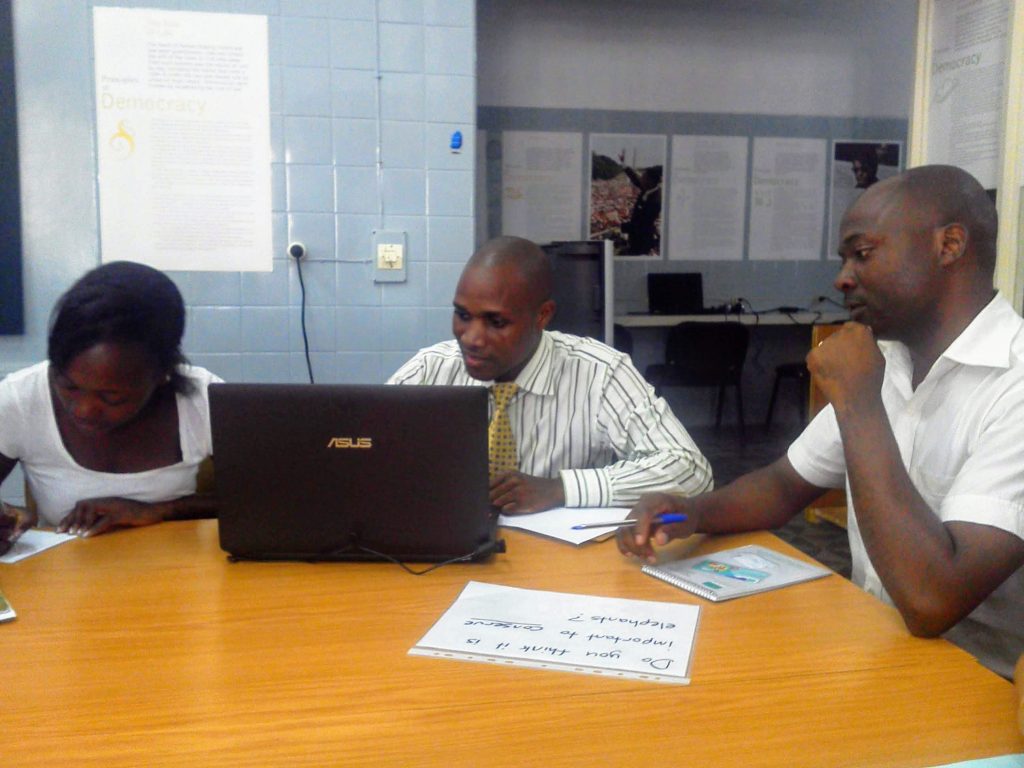
If you find yourself with slightly different levels in your group, first, let me say thank you for your effort! Keeping this system is one way we can deal with student-tutor matching, and our general lack of tutors. On the other hand, I know there are some issues that can arise in this situation, such as the issue I was called about last week. A tutor called saying one of her students was beginning level 1, and a newer student recently placed with her was ready to start the level two book. She wondered how she would work with them together…would she have to do two separate lessons from two books in one session? It seemed like a complicated situation. Let me relate the advice I gave her, and we’ll see what you think.
My first piece of advice was not to be concerned or stressed. Having one student that is at a somewhat higher level than other students is considered a pretty good dynamic by many educators, and is based on ideas by Lev Vygotsy, a social psychologist whose ideas are very influential in the field of education. His view is that learning is assisted when a more knowledgeable member of a social group helps a less knowledgeable member move from one level of skill to the next level, one that the learner couldn’t reach without a little help. So, if there are different levels, then you have the tutor AND the higher level student in a position to help the lower level student. The only thing to watch out for is when the learners are too far apart in skill, which is why I wouldn’t pair a level one with a level three.
So, hopefully that takes some pressure off! The next thing to do is to think about how best to design interactions during the session where we are addressing the lowest level learner by applying the skills of the higher learner, then finishing by having the tutor, as the most-skilled member of the group, helping the more advanced student get to the next level that he or she couldn’t reach alone. This is when artistry, creativity, and a little experimentation comes into play.
My advice was to divide the session time into three equal parts. In the first part, focus on a lesson of the lowest level student. While doing this, get the other student to take the lead and try and guide the lower student through a lesson while the tutor steps back and is there mainly to help out and guide the situation. Then switch gears and work on a lesson with the other student while the lower-level student helps out as best they can. Then, use the final third of the session to discuss topics from from both lessons as a group. This should boost everyone. The lower level will get good exposure to a lot of language, the higher level will get some good review and lots of opportunity to practice. Since the Lifeprints books have lessons based on different themes, it shouldn’t be too difficult to switch between lessons. In other words, they don’t necessarily build on the previous lesson, so you can jump in here and there and talk about counting, going to the bank, etc. The final discussion time is where the real learning will happen.
This may seem awkward at times, but I think you will see a rapid leveling out of both students because they will be using that language with each other. Using language is the most important part of language education. That’s when mastery happens.
Another thing that I find to be true is that more advanced students aren’t always as advanced as we might think at first. Unless you have been working with a student a long time, it could be easy to overestimate their skills based only on how well they seem to know something in the book. In other words, it’s easy for learners to recognize something they see in a book, but it’s harder for them to use language from recall. Again, mastery comes from discussion. When a student is able to talk about something fairly consistently, then you know they know it.
So, in sum, if you plan your session time to take advantage of the social dynamic, and you are sure to include some good discussion time, I think you will find a lot of fun and improvement in your groups, even if they aren’t at the exact same level. It’s ok to be open and honest about using this approach with your students. They’ll understand. Heck, I recently used this method in a college ESL program that had two different levels of students in it, and I got some positive feedback. It wasn’t always great, but the students appreciated it overall. Yours will, too.
 One of the challenges that faces our tutors, primarily our Conversation Corner leaders, is how to deal with attendees who are at a much lower level than the group average, or, who may not speak any English at all. I completely understand this problem, as I have been faced with it many times. It can be frustrating and disappointing to know that when a low-level learner tries to participate, it can throw off the vibe of the group; but also, we feel guilty that we aren’t helping that person learn. Well, I have some tried and true ideas that I think can help us all out, and which won’t require much extra effort on the part of the Conversation Corner coordinator.
 highly recommended way to learn because it goes beyond writing a definition for new vocabulary out of often abstract or unknown words, it helps us to envision new ideas. So, you could always save some time at the end of a session to have people draw something that sticks in their mind. You could then ask them to share with the whole group and explain it (if they aren’t too shy). Lots of great language can come out of these activities.
 Low skill in Health Literacy is believed to be a significant factor that prevents people in the demographic that we serve from accessing healthcare. According to Health.gov, “For many individuals with limited English proficiency (LEP), the inability to communicate in English is the primary barrier to accessing health information and services.” And, limited literacy skills overall are considered to be an indicator that a person is less likely to seek and obtain healthcare.
 First, all of our tutoring books (published by
  The Literacy Department likes to order books from a series called Oxford Bookworms. These are a line of books known as “hi-lo,” which means, “high interest, low level.” These are great books for literacy and ESL students to practice their reading skills. They come in many different levels of readers, and in both fiction and non-fiction. To find them, you can search the catalog at
  Like the Oxford Bookworms, this is a hi-lo series. All of the titles are original fiction, and they are also available at different reading levels. They can be found by searching the catalog for “rapid reads.” When the results pop up, do a search again at the top of the screen. This time change the option in the “Search By” field to
 Another online resource that I like is managed by the US Department of State. Everything on
  provide slow audio and vocabulary in context with definitions at the end.
 Similar to VOA, the BBC also offers a news-based English learning site called, “BBC-
 and makes you laugh so much you will always remember the word: thus MEMrise. On top of that, the software takes you through several stages of learning, beginning with an introduction to the word and its meaning, then you do a quick multiple choice quiz, eventually moving on to a fill in the blank quiz….each way building your memory. It is nice and repetitive, so you get lots of exposure to your vocabulary. It has a downloadable app that you could use, for example, while waiting in line at the grocery store. Use it!
 Finally, I would be amiss if I didn’t mention Mango Languages, which the library system subscribes to. All users in Hillsborough county should access Mango Languages through our